
Anyone planning a home renovation quickly discovers that the total cost is rarely as straightforward as it first appears. Even with a carefully prepared budget, expenses can shift once demolition begins, materials are selected, and structural or system upgrades reveal hidden issues. What starts as a well-planned project can easily become overwhelming when unexpected repairs, inaccurate estimates, and scope changes begin to stack up.
One of the most common reasons homeowners run into budget problems is treating a renovation as a single lump sum instead of breaking it down into individual components. Every stage of a remodel—from structural work and utilities to finishes and exterior upgrades—comes with its own cost drivers. Without separating these elements, it becomes difficult to identify where money is being spent or where adjustments can be made before costs spiral.
A more reliable approach is to structure renovation planning in phases. This means allocating budgets based on the sequence of work, starting with foundational and structural requirements before moving into finishing details and exterior enhancements. By organizing expenses in this way, homeowners gain clearer visibility into priorities, reduce the risk of overspending, and make more informed decisions throughout the project.
This guide will walk through a practical, step-by-step approach to planning and managing a home renovation budget. It will cover how to evaluate contractor estimates, anticipate commonly overlooked expenses, and structure spending in a way that keeps your project financially stable from the earliest stages of demolition to the final exterior improvements.
- Assessing the Scope of the Teardown and Establishing Contingency Funds
- Calculating Costs for Behind-the-Walls Infrastructure Upgrades
- Evaluating System Replacements vs. Repairs for Climate Control
- Estimating Long-Term ROI for Top-Down Weather Protection
- Prioritizing Material Quality Without Breaking the Bank
- Measuring Perimeters and Access Routes for Accurate Material Bids
- Phasing Outdoor Projects to Spread Out Capital Expenditure
- Conclusion

Assessing the Scope of the Teardown and Establishing Contingency Funds
The very first phase of any major property transformation is often the most unpredictable. Tearing away the old to make room for the new is an inherently destructive process, and it is the exact moment when a property reveals its darkest secrets. Water damage, outdated wiring, dry rot, and hazardous materials like asbestos or lead paint rarely announce themselves until the drywall comes down.
Because of this unpredictability, your budget for this initial phase requires the most padding. Many property owners make the mistake of assuming that breaking things apart is cheap and easy, but doing it safely and legally requires precision and capital.
-
Pad the Teardown Budget by 20%: A standard renovation requires a 10% to 15% contingency fund, but the teardown phase demands a strict 20% buffer. If you allocate $5,000 for clearing out your space, set aside an additional $1,000 specifically for unexpected discoveries. If you find a compromised load-bearing beam, that money will be absorbed instantly.
-
Require Itemized Bids for Waste Removal: Do not accept a flat-rate quote for this phase without understanding what it covers. You need to see exactly how dumpster rentals, daily haul-away fees, and municipal disposal taxes are being priced. Some municipalities charge exorbitant fees for disposing of heavy materials like concrete or hazardous waste, and you need to know who is responsible for those fees.
-
Factor in the Cost of Permits Early: Municipalities often require specific permits just to alter the footprint of a home or remove structural elements. Include permit fees in this initial budget category so you aren’t caught off guard before the work even begins.
While taking a sledgehammer to your own kitchen might seem like a fun way to save money, it is usually a false economy. Striking a hidden water main or accidentally removing a structural support will cost exponentially more to fix than the labor you saved. Hiring skilled demolition contractors is an upfront cost that actually protects your bottom line by ensuring the site is prepped correctly, safely, and legally for the builders who will follow.
Furthermore, you can actively control costs during this phase by negotiating salvageable material credits. If your property has antique fixtures, solid hardwood doors, or valuable copper piping, ask if the crew will discount their labor in exchange for keeping the scrap, or sell those materials yourself to offset the site-clearing costs.
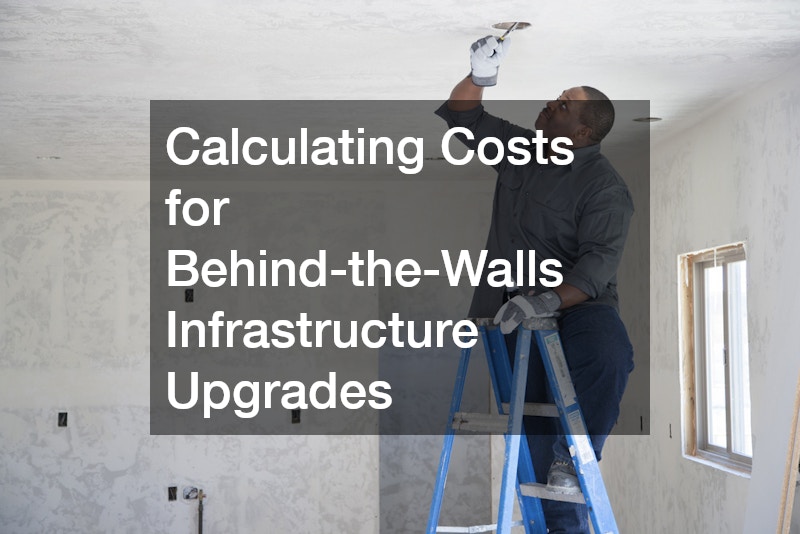
Calculating Costs for Behind-the-Walls Infrastructure Upgrades
Once the space is opened up, the focus shifts to the home’s skeleton. This phase involves the critical, invisible elements that dictate the property’s safety, function, and long-term efficiency. Budgeting for this stage is notoriously difficult because you are spending large sums of money on things you will never actually see once the drywall is finished. However, shortchanging this phase is the most dangerous financial mistake a property owner can make.
You must view behind-the-walls infrastructure as an investment in the home’s lifespan. Cutting corners here guarantees expensive, invasive repairs in the future.
-
Schedule Pre-Quote Camera Inspections: Never guess the condition of your home’s main lines. Before requesting quotes for pipe replacements or rerouting, pay for a video scope inspection. This service typically costs a few hundred dollars, but it provides a precise map of bellies, root intrusions, or collapsed sections. This allows you to get an accurate estimate for targeted repairs rather than a wildly inflated “worst-case scenario” bid.
-
Calculate Long-Term Utility Savings: When budgeting for the building envelope, don’t just look at the price tag of the materials. Calculate the projected energy savings over a five-to-ten-year period. Upgrading wall cavities with closed-cell spray foam might cost significantly more upfront than traditional fiberglass batts, but the monthly reduction in utility bills can entirely justify the initial capital outlay.
-
Synchronize the Trades to Prevent Labor Overlap: Time is money. Ensure that all the professionals working inside your walls are scheduled in a logical sequence before the walls are sealed.
Securing a licensed, highly vetted plumbing contractor early in the process is vital. If pipes are installed incorrectly or if the slope of a drain line is off by a fraction of an inch, you are looking at catastrophic water damage down the line. Similarly, bringing in a team of specialized insulation contractors to properly seal the building envelope before the drywall goes up will dictate your comfort and energy expenditures for decades.
To keep costs under control during this heavy infrastructure phase, have your tradespeople work simultaneously if the space allows, or back-to-back without delays. If the drywall crew shows up and the pipes aren’t finished, you will pay a fee for the delay. Strict scheduling is your best financial defense.
Evaluating System Replacements vs. Repairs for Climate Control
Climate control systems are among the most expensive components of a property, and deciding whether to fix an aging unit or completely replace it is a major budgeting hurdle. It is easy to default to the cheapest immediate option—a quick patch job—but this can lead to a cycle of endless repair bills that eventually exceed the cost of a brand-new system.
To navigate this, you need a highly analytical approach to auditing your current equipment and projecting its remaining lifespan.
-
Apply the “5,000 Rule”: This is a classic industry metric for deciding between repair and replacement. Multiply the age of your equipment in years by the estimated cost of the repair. If the resulting number exceeds $5,000, it is generally more financially prudent to replace the unit entirely. For example, a $400 repair on a 10-year-old system equals 4,000 (repair it). A $600 repair on a 10-year-old system equals 6,000 (replace it).
-
Factor in Regional Rebates and Tax Credits: High-efficiency climate systems often qualify for federal tax credits, state-level energy rebates, and incentives from local utility companies. When comparing the budget for a basic unit versus a high-efficiency unit, subtract these guaranteed rebates from the premium unit’s price. Often, the net cost difference is negligible.
-
Demand a Manual J Calculation: Never let anyone guess the size of the equipment you need based on the square footage of your home alone. A Manual J calculation factors in your home’s orientation to the sun, the quality of your windows, and your ceiling height. This prevents you from overspending on a massive, oversized unit that will short-cycle and burn out prematurely.
When you are looking at a full-house overhaul involving ductwork, furnaces, and comprehensive ventilation planning, a general HVAC contractor is the professional you need to consult for a master bid. However, if your heating system is fine but you have an isolated issue with cooling performance—perhaps in a sunroom or a newly added master suite—bringing in a dedicated air conditioning contractor to install a targeted mini-split system might offer a much more cost-effective and localized quote.
Cost control in this phase relies on matching the solution exactly to the problem. Do not replace an entire system if only a single zone is failing, but conversely, do not sink thousands of dollars into patching a machine that is legally obsolete due to phased-out refrigerants.
Estimating Long-Term ROI for Top-Down Weather Protection

Moving from the interior systems to the exterior, the financial focus shifts to the protective layers of the property. Budgeting for the highest point of your home is rarely an exciting way to spend money, but it is the most critical defense against the elements. A failure here compromises everything beneath it—from your drywall and hardwood floors to your newly updated electrical panel.
Treat this phase of the budget strictly as a long-term investment, prioritizing durability and warranty over the lowest immediate sticker price.
-
Compare Lifecycle Costs, Not Just Upfront Prices: An architectural asphalt shingle might cost $5,000 today and last 20 years. A standing seam metal roof might cost $12,000 today but last 60 years. If you plan to stay in the property long-term, the metal option is actually cheaper over its lifespan. Budget based on your intended holding period for the property.
-
Ask for “Per Square” Pricing: To easily compare different vendor quotes apples-to-apples, you need a standardized metric. In this industry, materials and labor are priced by the “square” (which equals 100 square feet). If one bid seems suspiciously low, check their per-square breakdown. They may be underestimating the actual surface area of your home to make their initial bid look attractive.
-
Budget for the Unseen Decking: The quote you receive is based on the assumption that the wooden decking beneath your current materials is healthy. Always add a 10% contingency specifically for replacing rotted plywood that is only discovered once the old materials are torn off.
It is absolutely crucial to compare comprehensive bids from at least three different roofing contractors before making a decision. Pricing in this specific trade can fluctuate wildly depending on the time of year, the size of the crew a company employs, and how easily they can access your property with heavy machinery.
A major cost-control warning for this phase: strongly advise against “overlaying.” Putting new protective materials directly over the old ones saves you the cost of a tear-off today, but it traps heat, adds massive structural weight to your home, and typically voids the manufacturer’s warranty on the new materials. Paying for a full tear-off is the only financially sound way to protect your investment.
Prioritizing Material Quality Without Breaking the Bank
After the structural and protective elements are funded, the budget usually moves into the highly emotional and aesthetic phase of interior finishes. This is the stage where financial plans most frequently derail. It is incredibly easy to fall in love with premium imported tiles, rare woods, and luxury fixtures, only to realize that outfitting a whole room in these materials will bankrupt the project.
Navigating this phase requires strict discipline and a strategic approach to where you place your premium dollars versus where you compromise.
-
Implement the “High-Low” Budgeting Trick: You do not need top-tier materials on every square inch of your property. Invest heavily in high-traffic, highly visible focal points—like a massive kitchen island or the primary bathroom vanity. Then, use high-quality but budget-friendly alternatives in secondary spaces like guest bathrooms, laundry rooms, or basement wet bars. This creates a luxurious feel overall without the luxury price tag.
-
Source Remnants for Smaller Projects: If you need stone for a small vanity, a fireplace hearth, or a laundry room folding area, never buy a full slab. Visit local stoneyards and ask to see their remnant yard. These are leftover pieces from larger jobs that are usually sold at a steep discount, saving you up to 50% on raw material costs.
-
Standardize Your Cabinet Boxes: If you want a custom look in your kitchen, budget for standard, prefabricated cabinet boxes but splurge on custom-painted, high-end doors and premium hardware. This hybrid approach saves thousands compared to fully bespoke cabinetry.
When it comes to stone and solid surfaces, remember that the raw material is only half the expense; the installation labor is just as critical. Hiring a highly experienced countertop contractor is non-negotiable. An amateur might offer a cheaper installation rate, but if they ruin a $3,000 slab of quartz by miscalculating an edge profile or creating highly visible, sloppy seams, you will have to buy the material twice.
To strictly control costs during the finishing phase, have all your sinks, faucets, and drop-in appliances purchased and physically on-site before templating begins. If a fabricator has the exact physical sink in front of them, the cuts will be perfectly accurate on the first try. Guessing dimensions from a spec sheet often leads to costly on-site recuts or entirely ruined materials.
Measuring Perimeters and Access Routes for Accurate Material Bids
As the interior nears completion, a comprehensive budget must pivot to the exterior property lines, entryways, and curb appeal. Budgeting for the exterior perimeter is heavily dictated by sheer volume and linear footage. A miscalculation of a few feet on a boundary line can result in hundreds of dollars in wasted materials or, worse, legal disputes with neighbors.
Accuracy in measuring and assessing the current condition of your exterior grounds is the only way to get reliable financial estimates for this phase.
-
Pull Official Property Lines: Never assume you know exactly where your property ends based on existing markers or old hedges. Before allocating a single dollar to perimeter work, pull your official property plat from the county. Building a structure, even a few inches onto municipal property or a neighbor’s yard, will result in fines and the total cost of tearing the work down.
-
Calculate Square Footage Meticulously for Driveways: Exterior entryways require massive amounts of raw material. Measure the exact square footage to decide what your budget can bear. Poured and stamped concrete offers high durability but comes with a premium price tag, while blacktop offers a lower barrier to entry but requires more frequent sealing and maintenance.
-
Assess the Sub-Base: The visible surface is only a fraction of the cost. If your exterior grounds have poor drainage, clay soil, or an eroding base, you will need to budget heavily for excavation and gravel grading before any final materials are poured or placed.
When gathering quotes, understand that reputable fencing contractors will base their pricing strictly on linear footage, the number of custom gates required, and the specific material chosen (e.g., standard treated wood versus premium low-maintenance vinyl). Similarly, asphalt paving contractors will give you a bid that is heavily weighted by the current condition of your sub-base and the heavy machinery access to your driveway. If they have to manually wheelbarrow materials because a truck cannot fit, labor costs will skyrocket.
A clever cost-control strategy for perimeter projects is to group neighborly disputes or shared boundaries into the budget conversation early. If you share a long property line with a neighbor whose side is also deteriorating, approach them about splitting the material and labor costs. Contractors will often give a slight discount for a larger, combined linear footage job.
Phasing Outdoor Projects to Spread Out Capital Expenditure
The final stage of property improvement involves the outdoor living spaces—patios, retaining walls, fire pits, and walkways. Because this phase happens last, it is usually the victim of an exhausted budget. Property owners often realize they have spent all their contingency funds inside the house and have nothing left for the backyard.
Instead of abandoning the exterior or settling for cheap, temporary fixes, the smartest financial strategy is to design a master plan that can be executed in distinct, budget-friendly stages over several years.
-
Plan the Vision, Execute in Phases: Work with a designer to create the ultimate, finalized layout for your outdoor space. Then, break that master plan into manageable financial chunks. For example, Year 1 might be purely structural, focusing on grading the yard and building necessary retaining walls. Year 2 could fund the patio pouring. Year 3 could be dedicated to aesthetic additions like built-in seating or fire features.
-
Prioritize Drainage and Leveling First: Never put expensive stonework on poorly prepped ground. If your budget is tight, spend your available funds on French drains, proper soil grading, and base compaction. Installing a luxury patio on shifting soil will result in cracking and sinking within a single freeze-thaw cycle, completely destroying your investment.
-
Source Local and Native Materials: Heavy materials like boulders, pavers, and flagstone cost a fortune to transport. You can drastically cut your material budget by choosing stones that are native to your specific region, eliminating the massive freight shipping costs associated with imported materials.
To make this phased approach work, it is highly recommended to collaborate with experienced hardscaping contractors who understand how to build a project that can be paused and seamlessly resumed later. They can ensure that the base preparations laid in Year 1 will perfectly accommodate the surface materials planned for Year 2, preventing any need to undo and redo work.
Cost control in the great outdoors is ultimately about patience. By spreading the capital expenditure out over multiple tax years or bonus cycles, you can achieve a high-end, resort-quality exterior without taking on high-interest debt or compromising the quality of the materials used.
Conclusion
Successfully navigating a property renovation without draining your bank account requires far more than just a hopeful estimate and a generic spreadsheet. It demands a highly detailed, category-by-category approach to financial planning. By acknowledging that a house is a complex system of interconnected trades—each with its own distinct materials, labor rates, and hidden risks—you can build a budget that actually withstands the realities of construction.
Remember that the cheapest bid is rarely the most cost-effective over the lifespan of a property. A lowball offer usually indicates missing details, inferior materials, or an unlicensed crew, all of which will cost you double in repairs down the road. Treat your property as an investment portfolio: vet your professionals thoroughly, read every line of your contracts carefully, and fiercely protect that 15% to 20% emergency reserve.
The best time to take control of your renovation finances is before a single tool is lifted. Take the chronological phases outlined in this guide and start building your master project spreadsheet today. By organizing your scope of work logically, you will be fully prepared to request your first batch of quotes, compare them with confidence, and bring your property vision to life without the financial stress.
