
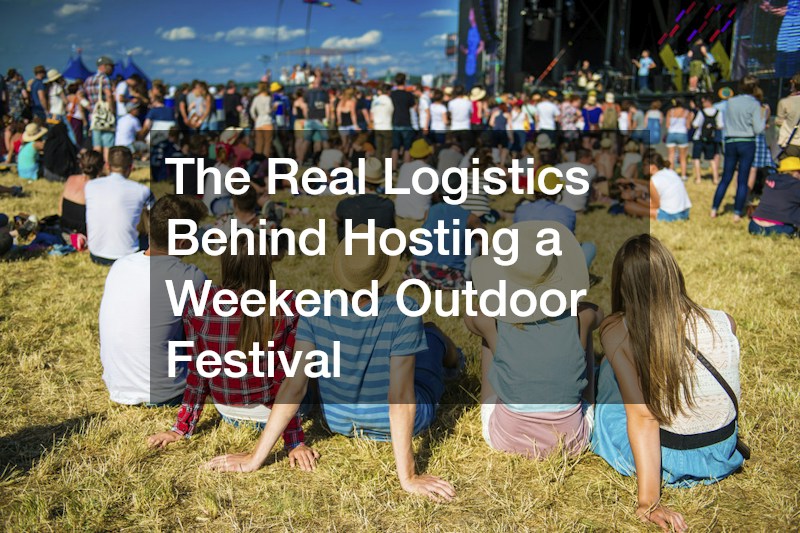
Behind every three-day lineup of music, food trucks, and string lights lies a dense web of permits, contracts, and emergency plans that most festival-goers never think about. If you are considering attending, volunteering, vending at, or even helping plan a weekend outdoor festival, understanding what actually goes into producing one can help you set realistic expectations and spot red flags before they become real problems. From waste management to medical readiness, the logistics are far more complicated than booking a stage and selling tickets. This outline breaks down the practical, often overlooked systems that make a safe, functional festival possible.
Transporting Stages, Gear, and Vendor Equipment
Getting a festival site built from an empty field into a functioning venue requires moving an enormous amount of equipment, and organizers rarely own all of it themselves. Many festival producers contract with business moving companies that specialize in large-scale freight, since stages, sound systems, generators, and vendor booths often need to travel from storage facilities or previous events to the festival grounds. These companies handle the scheduling complexity of multiple deliveries arriving in a tight window before gates open.
Timing these deliveries matters just as much as the transport itself. If trucks arrive out of sequence, crews can end up with staging equipment sitting idle while they wait on cabling or lighting rigs that should have arrived first. Experienced festival logistics teams build detailed load-in schedules that stagger arrivals by category, which keeps the site from becoming a bottleneck.
- Stage decking and trussing typically arrive first, days before gates open
- Sound and lighting equipment follows once the stage frame is secure
- Vendor trailers and booths are usually scheduled for the final 24 to 48 hours
- Perishable food supplies arrive last to avoid spoilage
Grading, Grounds Prep, and Heavy Machinery Needs
Most festival sites are not naturally flat, dry, or stable enough to handle thousands of pedestrians and heavy vehicles without some grading work beforehand. Organizers often turn to heavy equipment rental providers to bring in skid steers, graders, and compactors that level walking paths, build temporary access roads, and reinforce areas prone to mud. This is especially critical for multi-day events where rain can turn an otherwise fine field into a hazardous, ankle-deep mess by day two.
Beyond grading, heavy machinery is often needed for setting up larger structures like elevated viewing platforms, barricades, and loading docks for production trucks. Renting rather than owning this equipment allows festival producers to scale their site prep up or down depending on expected attendance, without carrying the overhead of machinery they would only use a few times a year.
- Skid steers for moving gravel, mulch, or fill dirt on walking paths
- Forklifts for unloading heavy staging and generator equipment
- Compactors to stabilize ground near entrances and high-traffic zones
- Aerial lifts for lighting rigs and signage installation
Restroom Facilities and Sanitation Planning
Nothing sours a festival experience faster than inadequate restrooms, and organizers spend a surprising amount of time planning this part of the event. Standard portable toilets are the baseline, but many festivals now offer a luxury restroom trailer rental option near VIP areas or camping sections, giving attendees climate-controlled stalls with running water and real sinks. These upgraded units have become a selling point for premium ticket tiers at larger events.
The ratio of restrooms to attendees is calculated well in advance, and organizers typically plan for one unit per 75 to 100 guests for a single day, adjusting upward for multi-day camping festivals where usage is constant. Placement matters too, since clustering units too far from stages or campgrounds leads to long walks and longer lines. Servicing these units throughout the weekend is just as important as the initial setup.
- Standard units are placed near stages, food courts, and campgrounds
- Upgraded trailers are often reserved for VIP or backstage areas
- Handwashing stations are required near all food vendor zones
- Servicing schedules are set for at least once daily during multi-day events
Wastewater and Septic System Management
Large outdoor events generate a surprising volume of wastewater, especially when restroom trailers, food vendors, and on-site showers are all running at once. Many festival grounds rely on temporary holding tanks that need regular emptying, and organizers often schedule commercial septic system pumping multiple times over a single weekend to prevent overflow. Skipping or delaying this service is one of the fastest ways a festival can end up with serious sanitation complaints.
Venues that host events regularly sometimes have permanent septic infrastructure installed specifically to handle seasonal festival traffic, but even these systems need monitoring during peak usage. Organizers typically coordinate pumping trucks to arrive during off-peak hours, like early morning before gates open, so the service doesn’t interfere with guest traffic or create unpleasant odors near high-traffic areas.
On-Site Medical Teams and Emergency Response Plans
Every well-run festival has a medical plan that goes far beyond a first-aid tent, because large crowds combined with heat, alcohol, and physical activity create predictable injury patterns. Organizers typically contract licensed EMTs or paramedics to staff on-site medical stations, and larger festivals coordinate directly with local hospitals to ensure capacity for serious incidents. Response time matters enormously here, since a medical issue at a crowded festival can take far longer to reach than it would on an open street.
Festivals also need clear protocols for weather emergencies, lost persons, and crowd control incidents, not just physical injuries. These plans are usually reviewed with local fire and police departments before permits are even approved, since emergency access routes need to be wide enough for ambulances to reach any point on the grounds.
- Medical tents are placed near main stages and camping areas
- Golf carts or ATVs are used to reach patients faster through crowds
- Weather monitoring systems track lightning and heat index in real time
- Lost child and reunification procedures are posted at info booths
Liability, Insurance, and Legal Preparedness
Accidents happen even at the most carefully planned festivals, and organizers typically carry general liability policies ranging from $1 million to $5 million per occurrence, sometimes layered with umbrella coverage for larger events. This insurance is meant to cover everything from slip-and-fall incidents to structural failures like a collapsed stage or tent.
Many venues and municipalities now require proof of coverage before issuing a permit, along with being named as an additional insured on the policy. Despite these precautions, attendees who are seriously injured sometimes find themselves needing to consult personal injury lawyers to determine whether the event’s safety measures met reasonable standards. This might involve reviewing crowd density calculations, security staffing ratios, or whether weather warnings were acted upon quickly enough.

In cases involving concussions, heat stroke, or crush injuries, these consultations can turn into formal claims against organizers or vendors. Festival contracts and ticket waivers often attempt to limit liability by having attendees acknowledge the inherent risks of large gatherings. These waivers don’t always hold up in court, however, particularly if gross negligence is involved, such as ignoring a known hazard or failing to maintain adequate emergency exits. Courts in many jurisdictions have struck down overly broad waiver language, which is why experienced organizers also carry workers’ compensation, liquor liability, and weather cancellation insurance as additional layers of protection.
Parking lots and access roads present their own risks, particularly when thousands of vehicles and motorcycles converge on a single venue over a short window. Festival organizers often lean on volunteer staff or off-duty officers to direct traffic across fields or gravel lots never designed for that kind of volume, and that improvisation is exactly where things tend to go wrong. Dust clouds, unmarked ruts, and vehicles backing out without a clear sightline all raise the odds of a collision before attendees even reach the gate.
Nighttime load-out is particularly dangerous: strings of festival lighting rarely illuminate parking areas the way a municipal street would, and fatigued drivers leaving after a long day of heat and noise are more prone to misjudging distances. Someone involved in a serious collision near festival grounds may want to speak with a motorcycle accident attorney, since these cases often involve unique factors like inadequate lighting, poor signage, or overcrowded temporary parking areas. These incidents also raise messier liability questions than a typical roadway accident, since multiple parties — the venue owner, the event producer, a third-party parking vendor — may share responsibility for conditions on site.
An attorney experienced in these claims can help sort out which insurance policy actually applies and whether the event’s safety planning met a reasonable standard of care. Understanding these legal angles beforehand isn’t about expecting the worst, but about knowing your options if something does go wrong.
Choosing Legal Help If Something Goes Wrong
If an injury does occur at a festival, the process of determining fault and seeking compensation can be confusing, especially when multiple vendors, contractors, and the venue itself may share responsibility. A slip near a food truck, a collapsed tent stake, or a malfunctioning stage rail can each point to a different responsible party, and sorting that out usually isn’t obvious right after the incident. An experienced injury lawyer can help sort through which party’s insurance applies, since festival liability is often split between the event producer, individual vendors, and even equipment rental companies.
Many festivals operate under layered contracts where vendors carry their own general liability policies separate from the producer’s event coverage, which means a claim might need to be filed against two or three insurers simultaneously. A lawyer familiar with event-related claims will know how to request incident reports, vendor contracts, and rental agreements that reveal who was actually responsible for maintaining the equipment or space in question.
Timing matters too. Some states impose notice requirements or shorter statutes of limitations when a government-owned venue or public park is involved, sometimes as little as six months to file a notice of claim. This is one area where trying to handle things alone can lead to missed deadlines or undervalued claims, particularly when an insurance adjuster offers a quick settlement before the full extent of an injury is even known.
Not every attorney has experience with the specific challenges of event-related injury claims, so it’s worth researching credentials before signing with anyone. Some of the best accident attorneys in a given region specialize in premises liability and crowd injury cases specifically, which tend to involve more complex evidence gathering than a standard car accident claim.
Festival incidents often involve multiple potentially liable parties — the venue owner, the production company, security contractors, vendors — and sorting out who’s actually responsible requires someone who understands how these overlapping contracts and insurance policies typically work. When vetting a firm, ask directly how many similar cases they’ve handled in the past five years and what the outcomes looked like. A lawyer who regularly deals with slip-and-fall claims at retail stores isn’t necessarily equipped to untangle a crowd-crush injury involving faulty barricades, inadequate staffing, or a negligent third-party vendor. Request references or case summaries that demonstrate direct experience with outdoor events, concerts, or large public gatherings specifically. Reviews, case history, and a clear explanation of contingency fees are all reasonable things to ask about during an initial consultation.
Most personal injury attorneys work on contingency, typically taking somewhere between 25% and 40% of any settlement or award, so get that percentage in writing before anything is signed. It’s also worth asking how they handle upfront costs like expert witness fees or accident reconstruction, since some firms advance these expenses while others expect reimbursement regardless of outcome. Finally, consider response time as a practical filter. A firm that takes two weeks to return a call isn’t a good fit when evidence like video footage, witness statements, or torn safety equipment needs to be preserved within days of an incident.
- Ask whether the attorney has handled event or premises liability cases before, ideally involving festivals, concerts, or large public gatherings
- Request references or case outcomes from similar incidents, not just general litigation experience
- Request a clear breakdown of contingency fees before signing anything — typical rates run 25-40% depending on case complexity
- Clarify who covers upfront costs like filing fees, expert witnesses, and investigators if the case doesn’t settle
- Gather photos, witness contacts, and incident reports as soon as possible, ideally within 24-48 hours while memories are fresh
- Note exact locations, weather conditions, and any signage or barriers present at the time of the incident
- Keep medical records organized in case a claim takes months to resolve, including initial ER visits, follow-ups, and billing statements
- Track lost wages and related expenses separately, since these often factor into final settlement calculations
Hosting or attending a weekend outdoor festival involves far more coordination than most people realize, from the trucks hauling in staging equipment to the septic trucks quietly servicing restrooms before dawn. Knowing what goes on behind the scenes can help you ask better questions, whether you’re buying a ticket, signing up to vend, or helping plan the event yourself. If you take one thing away, let it be this: the festivals that run smoothly are the ones where every logistical detail, from grading the field to planning for emergencies, was treated as seriously as the headline act.
